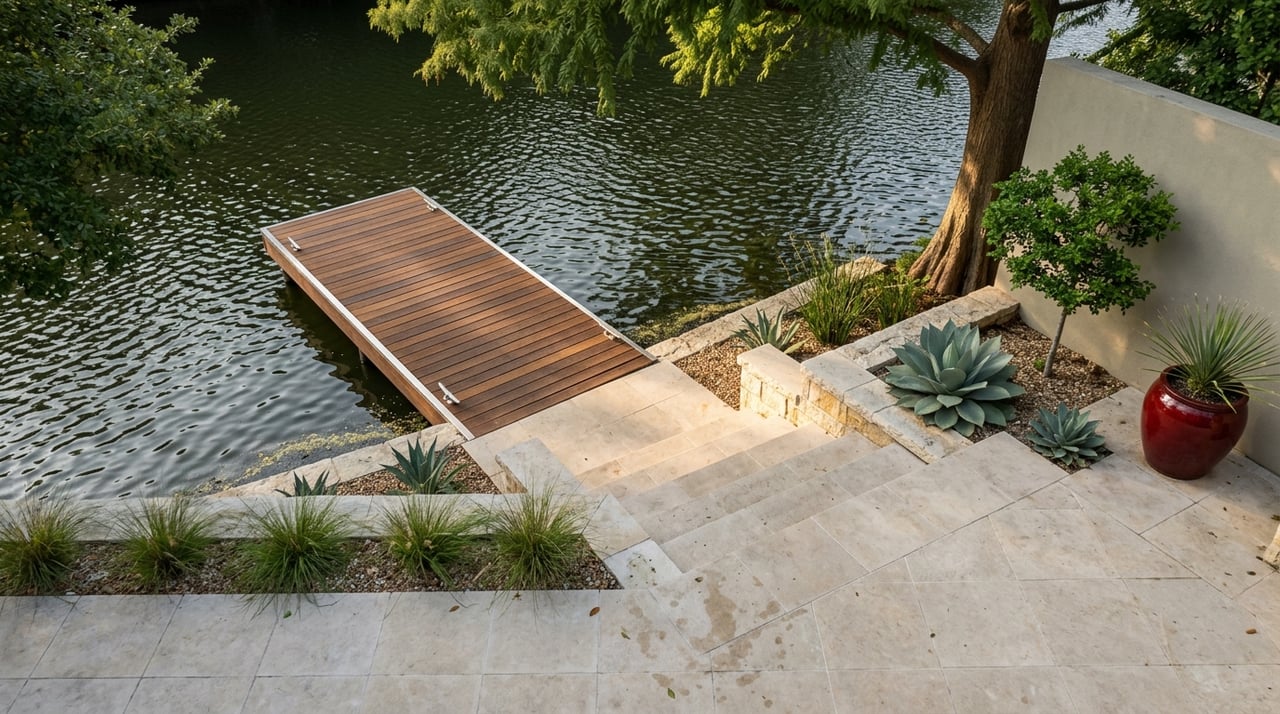
If your idea of lakefront living includes calm mornings, private shoreline, and fewer weekend disruptions, buying on Lake Austin takes more than spotting a pretty house online. In 78732, true waterfront is limited, regulations shape what you can actually use, and two properties with similar photos can offer very different day-to-day experiences. This guide will help you understand what really matters, what to verify before you make an offer, and how to pursue a quieter Lake Austin retreat with confidence. Let’s dive in.
Why quiet waterfront is hard to find
Lake Austin is a finite waterfront market, not a place where new shoreline can simply be created. The lake is a reservoir on the Colorado River, and under normal operations it is managed around a 492.8-foot normal pool elevation. Because shoreline is limited and the lake can still rise during flood events, truly usable waterfront carries lasting value.
The broader Austin market has loosened compared with prior years, but that does not mean quiet Lake Austin inventory is easy to find. In Q1 2026, the Austin-Round Rock-San Marcos MSA had 33,751 active listings and 5.5 months of inventory, while the City of Austin had 3,653 active listings and 5.4 months of inventory. Even so, Lake Austin waterfront remains constrained by limited shoreline, overlay rules, dock limits, and steep terrain.
Recent active listings also show how quickly pricing moves into the luxury tier on Lake Austin. Examples have ranged from about $4.99 million to $14.75 million, with value tied to frontage, dock rights, acreage, and redevelopment potential. That does not mean every property will look the same, but it does show that buyers are competing for a scarce asset.
What quiet means on Lake Austin
A quiet retreat is usually about more than the home itself. On Lake Austin, peaceful living often depends on where the property sits in relation to public ramps, marinas, bridge pinch points, and stretches of heavier weekend boat traffic. If serenity is your goal, the map matters as much as the floor plan.
The City of Austin has slow and no-wake navigation control zones around Pennybacker Bridge and immediately upriver of Tom Miller Dam, near Oyster Landing Marina and Walsh Boat Landing. These areas can attract more movement on the water, which may affect noise, traffic, and your sense of privacy. A home farther from these activity nodes may deliver the calmer setting you want.
Lake Austin also has no curfew, which is important to understand if you are expecting the lake to go fully quiet at night. At the same time, the city enforces no-wake zones, vessel registration rules, and personal flotation device requirements. There are also holiday-period restrictions on personal watercraft and similar devices during Memorial Day weekend, July 3 to 4, and Labor Day weekend.
Docks shape the lifestyle
On Lake Austin, a dock is not just an accessory. It can define how you use the property, how private the shoreline feels, and how much future flexibility you have. That is why dock due diligence should happen early, not after you are emotionally committed.
Construction on, under, or next to the water generally requires review and permits from the City of Austin. An approved site plan or site-plan exemption is required before a building permit can be issued. After construction, the dock must be registered, and residential registrations must be renewed every five years.
The city also requires dock addressing so public safety can identify structures from the water. For single-family lots, a dock generally may not exceed 20% of shoreline frontage. If a dock extends more than 30 feet or more than 20% of the channel width, Board of Adjustment approval may be required.
Boat ramps are prohibited within Austin city limits. That means some properties that look ideal in listing photos may be less functional than expected for your intended use. Two waterfront homes can look similar online, but one may have meaningfully better legal dock usability than the other.
Shoreline privacy includes vegetation
A quiet retreat is also about how the shoreline functions over time. On Lake Austin, aquatic vegetation can affect boating access, maintenance costs, and the day-to-day feel of the property. This is especially important if you want easy water access from your own dock.
The City of Austin reported that hydrilla covered about 37% of the lake in February 2026, with 592 acres identified. Dense mats can impede boats and affect shoreline usability. Herbicides are not allowed on Lake Austin, so management relies on grass carp and mechanical removal.
For you as a buyer, that means shoreline maintenance is not a minor detail. It should be part of your due diligence and operating budget from the start. A calm cove may feel ideal, but you still need to understand how vegetation conditions could affect access and upkeep.
Verify what the property actually is
Before you focus on finishes or views, confirm the legal and physical reality of the parcel. Austin’s Property Profile tool and zoning verification resources help establish what rules apply to a given property. On Lake Austin, this step matters because a parcel may fall within the LA district, the Lake Austin overlay, city limits, or a more complex jurisdictional situation.
In the Lake Austin district, the shoreline is defined by the 492.8-foot topographic contour line. The code also creates a shoreline setback area that limits what can be built there. For most LA lots, the shoreline setback is 75 feet, though some older platted lots and certain tracts may be treated differently, including a 25-foot setback when the front line is 200 feet or less from the shoreline.
This is why shoreline should never be treated as a visual estimate. The legal shoreline is a survey and zoning question. If you are buying for privacy, expansion potential, or future improvements, this distinction is critical.
Watch the slopes and site limits
On Lake Austin, steep topography can quietly reshape your plans. A lot may appear large on paper, yet the buildable area may be much smaller once slope, drainage, and utility constraints are factored in. If you hope to add onto the home later, this step is especially important.
Development is prohibited on land with a gradient greater than 35% in the LA district. Sewage holding tanks, effluent disposal sites, and drainfields are also heavily restricted. In practice, these rules can affect whether you can expand the home, rework the site, or add features that support a retreat-style property.
That is why buyers should review survey details, topography, and site constraints before writing an aggressive offer. A home may feel turnkey today, but your long-term flexibility may be limited by the land itself.
Floodplain review comes first
Floodplain analysis should be standard for any Lake Austin waterfront purchase. Lake Austin is a pass-through reservoir, and the smaller Highland Lakes, including Lake Austin, do not have flood-storage capacity. They typically operate within about a one-foot range, but they can rise well above normal levels during floods.
Austin’s floodplain regulations state that both City of Austin rules and NFIP rules apply. A site plan is required for development in the 100-year floodplain, and building or parking encroachment is prohibited in the 25-year floodplain and restricted in the 100-year floodplain. These are not small details if you are buying for future use, renovation, or dock-related improvements.
Flood risk can exist even outside the highest-risk mapped zones. That is why floodplain maps, elevation, erosion protection, and dock design all deserve careful review. On Lake Austin, flood diligence is a central part of buying well.
Budget for insurance early
Flood insurance should be part of your upfront math, not a last-minute surprise. Lenders for federally backed loans generally require flood insurance for buildings in a Special Flood Hazard Area. Homeowners insurance also typically does not cover flood damage.
Even if a home is outside a mapped Special Flood Hazard Area, flood risk may still exist. For a waterfront property, it is wise to request insurance quotes early in the process. This gives you a clearer picture of carrying costs before you finalize your offer strategy.
Financing looks different here
Many Lake Austin homes sit well above conventional loan thresholds. For 2026, the FHFA one-unit conforming loan limit in Travis County is $832,750. Because many waterfront properties exceed that amount, jumbo financing or cash is often part of the conversation.
That changes how you prepare. A strong pre-approval, proof of funds, reserve documentation, and a lender familiar with unique waterfront collateral can all make your offer more competitive. In this niche, clean execution often matters as much as headline price.
Appraisal risk also deserves attention. On a one-of-a-kind waterfront property, comparable sales may be limited, and value can hinge on land, frontage, dock usability, views, and redevelopment potential. If you are financing, that makes early planning even more important.
Build a smart offer strategy
In a low-turnover market like Lake Austin, preparation tends to beat speed alone. The best-positioned buyers usually line up financing early, assemble proof of liquidity, and review insurance, dock, floodplain, and survey issues before they write a strong offer. That reduces friction when the right property appears.
It also helps to think beyond active listings. On Lake Austin, approved plans, existing legal dock rights, and ready-to-use waterfront infrastructure can carry significant value. Off-market opportunities, expired listings, and withdrawn properties may also offer a path to the quiet retreat you want.
This is especially true if your goal is privacy without a long entitlement timeline. A property with legal shoreline usability and fewer unresolved issues may be more valuable to you than a home with prettier photos but harder constraints.
What to prioritize in 78732
If you are searching in 78732, focus on four core filters first. These can help you separate a truly peaceful waterfront retreat from a property that is simply near the water.
- Location on the lake: Look at proximity to marinas, public launch areas, bridge activity, and busier traffic zones.
- Dock legality and usability: Confirm permits, registration, frontage limits, and whether the dock setup fits how you want to live.
- Site feasibility: Review shoreline setbacks, slope restrictions, floodplain impacts, and future improvement potential.
- True carrying costs: Budget for jumbo financing, insurance, shoreline maintenance, and vegetation management.
When all four line up, you are much more likely to end up with a property that feels restful in daily life, not just impressive during a showing.
A quiet waterfront retreat on Lake Austin is rarely a simple purchase, but it can be a very rewarding one when you buy with clarity. The right property combines privacy, legal shoreline usability, realistic site potential, and a financial plan that accounts for the realities of waterfront ownership. If you want a process-driven approach to finding and evaluating a Lake Austin retreat, Meryl Hawk can help you move with confidence.
FAQs
What makes a Lake Austin home feel quieter in 78732?
- Properties farther from public ramps, marinas, bridge choke points, and heavier boat-traffic stretches often offer a calmer setting.
What dock rules should Lake Austin buyers know?
- Docks generally require City of Austin review, registration, and periodic renewal, and single-family dock size and extension are subject to frontage and width limits.
What is the shoreline setback in the Lake Austin district?
- For most LA lots, the shoreline setback is 75 feet, though some older platted lots and certain tracts may have different treatment.
Why is floodplain review important for Lake Austin waterfront homes?
- Development rules can limit what you build or change in the 25-year and 100-year floodplains, and Lake Austin can rise above normal levels during floods.
Do Lake Austin buyers need flood insurance outside high-risk zones?
- Flood risk can still exist outside mapped high-risk zones, so it is wise to price flood insurance early even if it is not lender-required.
What financing is common for Lake Austin waterfront purchases?
- Because many properties exceed the 2026 Travis County conforming loan limit of $832,750, jumbo financing or cash is often common.
How can you tell if a waterfront lot has future expansion potential?
- Review zoning, shoreline setbacks, slope limits, floodplain status, survey details, and utility constraints before assuming the site can support additions or major changes.