Lost Creek vs. Other West Austin Neighborhoods: Which One Is Right for Your Family in 2026?
If you've spent any time searching for a family home in Austin, Texas, you've probably heard that West Austin is where the good stuff is. And you're not wrong. The western corridor of the city has long been considered the holy grail for families chasing top-rated schools, Hill Country views, and a lifestyle that balances suburban peace with genuine proximity to the city's heartbeat. But here's the thing — West Austin is not a monolith. It's a collection of distinct neighborhoods, each with its own personality, price point, and set of tradeoffs. So where does Lost Creek fit into all of this, and could it actually be the smartest move for your family in 2026?
Why West Austin Is Still the Gold Standard for Austin Families
There's a reason people keep gravitating toward West Austin, even as the broader Austin market cools from its pandemic-era peak. The combination of Eanes Independent School District, mature tree canopy, access to the Barton Creek Greenbelt, and relatively short commutes to downtown creates a cocktail that's very hard to replicate elsewhere in the metro. Eanes ISD received an A rating with a score of 94 out of 100 for both the 2023–24 and 2024–25 school years, with every campus in the district earning an A — a remarkable consistency that drives significant property value premiums across the corridor. Compare that to Austin ISD, which serves neighborhoods like Tarrytown and Clarksville and received a C rating with a score of 79 out of 100 in 2025, and you start to understand why West Austin commands the price tags it does. For families relocating from out of state, especially from high-tax environments like California, the appeal of Texas's zero state income tax paired with best-in-class public schools is often the decisive factor. West Austin isn't just a lifestyle choice — it's a long-term financial strategy.
What Makes the West Austin Corridor So Special?
Think of West Austin as a series of concentric circles, each neighborhood sitting at a different distance from downtown and offering a slightly different version of the same core promise: safety, schools, nature, and space. The neighborhoods most commonly compared by relocating families are Lost Creek, Westlake Hills (West Lake Hills), Barton Creek, Tarrytown, and Rollingwood. Each one delivers on the fundamentals, but the devil is in the details. A family with young kids and a $1.2M budget faces a completely different calculus than a family with teenagers and a $2.5M budget. What you need to know going in is that the neighborhoods are not interchangeable — and the one that seems most prestigious on paper may not actually be the best fit for your specific situation. Let's break it all down.
Getting to Know Lost Creek in 2026
Lost Creek doesn't have the same name recognition as Westlake Hills, and it rarely shows up first in a Zillow search when someone types "best Austin neighborhoods." That's actually part of what makes it interesting. West Austin Realtor Brandon Galia, who has helped multiple families buy in this corridor, calls Lost Creek "the neighborhood buyers discover after they've already looked everywhere else." The neighborhood is tucked into the hills just south of Bee Cave Road and east of Loop 360, and it genuinely rewards the buyer who takes the time to explore it. Unlike newer master-planned communities that feel curated to the point of sterility, Lost Creek has the kind of organic, lived-in character that takes decades to develop — because it has been developing since the 1970s.
The Character and Feel of Lost Creek
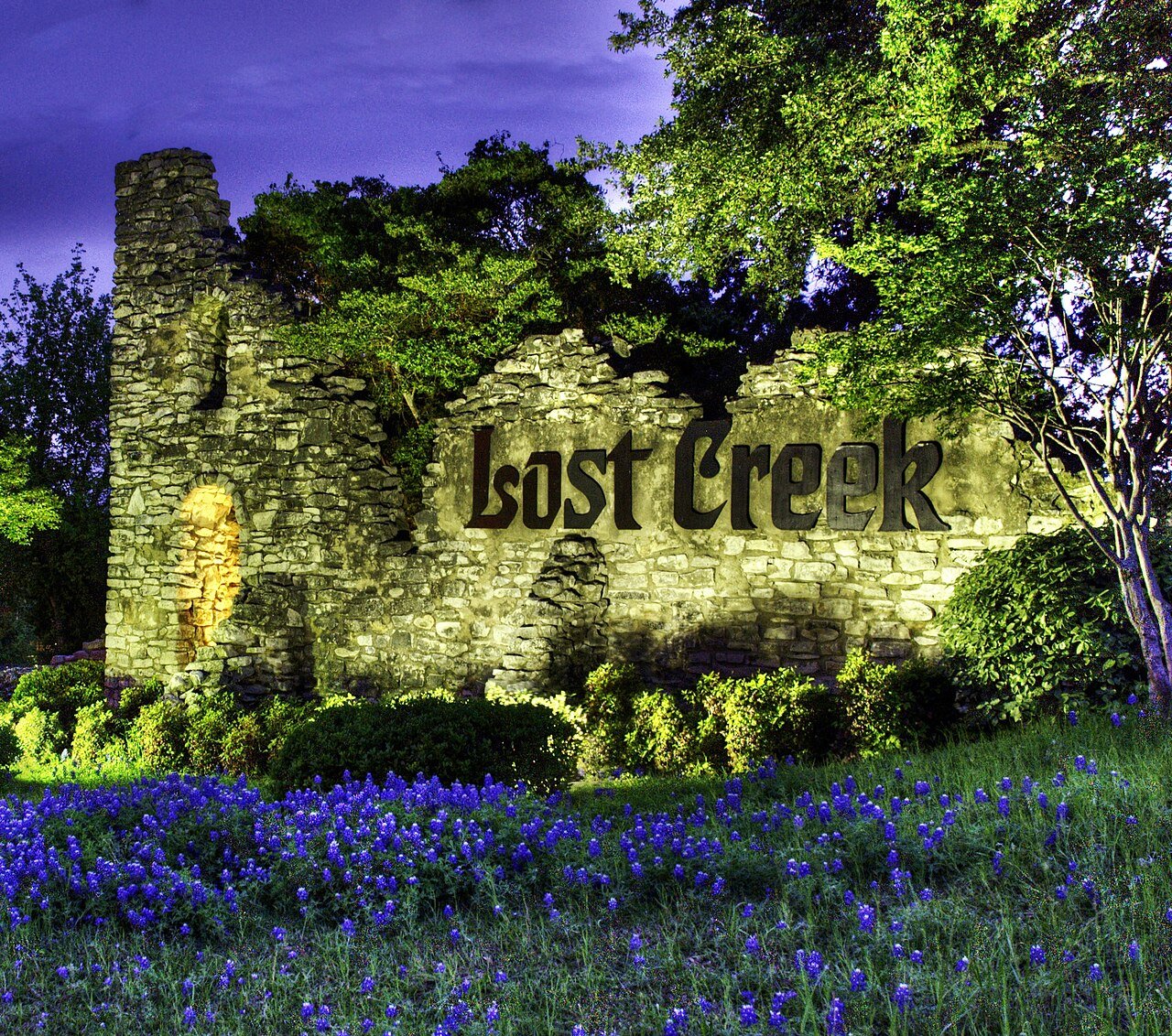
Established in the early 1970s, Lost Creek was envisioned as a premium residential community within the desirable Eanes Independent School District. The developers aimed to create a tranquil enclave with modern conveniences such as underground utilities, a sewage system, and a country club. Today, the Lost Creek area spans over 775 acres and holds approximately 1,200 homes, many of them custom-built. The Lost Creek Neighborhood Association (LCNA), established in 1976, has been instrumental in the community's preservation and growth, spearheading projects like park development and advocating for zoning and land-use policies that align with the community's values. Walking the streets of Lost Creek on a Saturday morning, you'll notice the mature live oak canopy creates a natural tunnel effect over the roads, the yards are generous and unhurried, and neighbors actually know each other's names. It's the kind of neighborhood that doesn't feel like it's trying hard to be anything — because it's already exactly what it is.
Lost Creek Home Prices and Real Estate Trends in 2026
Here's where Lost Creek starts to pull ahead in the value equation. Home prices in Lost Creek range from approximately $800K for older, un-renovated homes to $2.5M+ for fully updated or rebuilt properties on larger lots. The sweet spot for most families is the $1M to $1.6M range, which typically gets a 3–4 bedroom home on a quarter-acre-plus lot with mature trees. Compare this to neighboring Westlake Hills, which has a median listing price of $2.60 million, and you're looking at a meaningful gap for what amounts to the same school district access. The median sale price for homes in Lost Creek, Austin over the last 12 months is $1,100,000, down roughly 20% from the previous 12 months — meaning buyers who act in 2026 are entering at a favorable point in the cycle. That kind of correction in a fundamentally sound, supply-constrained neighborhood is an opportunity, not a warning sign.
Lost Creek vs. Westlake Hills: The Great Debate
This is the comparison that comes up most often, and understandably so. Westlake Hills — or West Lake Hills as it's formally incorporated — is the most prestigious address in the corridor, full stop. The highest-priced Austin ZIP code in 2026 is 78746, covering Westlake and West Lake Hills, with a year-to-date median sale price of $2,394,287. That number tells you a lot about the demand and prestige attached to the Westlake label. But does the premium actually translate into a meaningfully better family experience? That depends heavily on what your family prioritizes.
School Districts — Is There Really a Difference?
This is probably the most important question for families, and the answer is more nuanced than most people realize. Both Lost Creek and Westlake Hills are served by Eanes ISD — the same district, the same flagship high school. The neighborhood is part of the highly acclaimed Eanes Independent School District, with nearby schools such as Forest Trail Elementary, West Ridge Middle School, and Westlake High School — all consistently ranked among the best in Texas. So the idea that you need to pay Westlake Hills prices to access Westlake High School is simply not accurate. Both neighborhoods feed into the same excellent district. West Ridge Middle School has an A+ Niche grade, a student-teacher ratio of 12:1, and an average review score of 4.7. Westlake High School has an A+ Niche grade, a student-teacher ratio of 14:1, and an average review score of 4.2. Your child gets the same classroom when you buy in Lost Creek at $1.2M as they would if you bought in Westlake Hills at $2.4M. That's a compelling argument for Lost Creek, and one that not enough families hear before they sign a contract.
Price Per Square Foot: Where Does Your Dollar Go Further?
Westlake Hills commands roughly $756+ per square foot in active listings as of early 2026, while Lost Creek homes can be acquired for considerably less on a per-square-foot basis. That price gap buys you something specific: a larger lot, a more established canopy, and significantly less construction noise. Lost Creek was built out in the 1970s through 1990s. The neighborhood is mature. The trees are mature. The infrastructure is settled. You are not buying next to a lot that becomes a spec build in six months. If you're prioritizing dollar-for-dollar value within the Eanes ISD corridor, Lost Creek is the sharpest proposition on the board right now. Westlake Hills offers slightly better downtown proximity and a certain cachet that still commands a premium — but if you're being honest with yourself about what your family actually needs day-to-day, Lost Creek delivers 90% of the Westlake experience at a fraction of the cost.
Lost Creek vs. Barton Creek: Nature Lovers at a Crossroads
Barton Creek is the neighborhood that consistently intimidates buyers with its range — you can spend $1.5M or $7M in this zip code, and both buyers would describe themselves as living in Barton Creek. As of Q1 2026, average home values in Barton Creek range from $2.18M to $2.22M, representing a 3.1% year-over-year increase. Homes are spending an average of 92 to 115 days on market, and buyers are successfully negotiating approximately 9–10% below the original list price. That extended time on market is actually a signal for savvy buyers — Barton Creek is a negotiating opportunity in 2026. But it's also a more complicated neighborhood than it first appears.
Lifestyle and Amenities Compared
Both Lost Creek and Barton Creek offer country club living, but the experiences are different in texture and character. Lost Creek Country Club boasts three swimming pools, 16 tennis courts, a championship golf course, and a state-of-the-art fitness facility — providing a resort-style lifestyle within the neighborhood. Barton Creek, by contrast, anchors its identity around the Omni Barton Creek Resort and its proximity to the Barton Creek Greenbelt's most dramatic terrain, including waterfalls and serious rock climbing. If your family leans toward golf memberships and pool days within walking distance of home, Lost Creek wins on convenience. If you want your weekends to feel like a wilderness adventure with luxury amenities nearby, Barton Creek has an edge. Neither is objectively better — it's a lifestyle question, and you need to be honest about which version of the weekend actually sounds like your family.
HOA, Zoning, and Total Cost of Ownership
Here's where Lost Creek quietly outperforms Barton Creek in ways that don't show up in the listing price. Compared to Barton Creek, Lost Creek offers a different country club experience and better proximity to downtown. You are ten minutes closer to downtown, fifteen minutes closer to South Lamar, and you skip the HOA structure that parts of Barton Creek require. Additionally, the school district situation in Barton Creek is a genuine complication — the neighborhood is split between two districts: some sections are zoned for the highly-rated Eanes ISD, while others are zoned for Austin ISD. This internal division creates significant price variations within Barton Creek itself. Lost Creek, by contrast, sits entirely within Eanes ISD. There's no address verification game to play, no risk of landing on the wrong side of a school boundary line. That consistency is worth something, especially when you're making a multi-million dollar decision.
Lost Creek vs. Tarrytown: Old Austin Charm Meets Hill Country Peace
Tarrytown is the neighborhood that attracts buyers who want the soul of Austin — the live music, the walkability, the tree-lined streets with historic architecture — but still want to be in a residential neighborhood rather than a high-rise. It's compelling, particularly for families moving from walkable cities who aren't ready to fully embrace suburban car-dependence. Tarrytown offers the most accessible entry price of the four neighborhoods, with reconciled median sold prices ranging from $1.55M to $1.95M and price per square foot from $653. That puts it in an interesting middle zone — more expensive than Lost Creek but less than Westlake Hills, and geographically much closer to downtown.
Walkability and Urban Access
Tarrytown is genuinely walkable by West Austin standards. Residents can reach Whole Foods, central Austin restaurants, and downtown within a short trip by bike or car, and the neighborhood has a vibrancy that more removed West Austin neighborhoods simply don't offer. If someone on your family works downtown or deeply values being plugged into Austin's cultural scene, Tarrytown is a serious contender. But if your family's lifestyle is oriented toward outdoor recreation, large lots, and a quieter pace, Tarrytown's urban energy can feel more like friction than feature. The smaller lot sizes and denser feel make it less suitable for families with dogs, young children who need room to roam, or anyone who finds weekend peace in their own backyard rather than a neighborhood coffee shop.
School District Reality Check in Tarrytown
This is where Tarrytown's appeal runs into a significant structural problem for many families. Tarrytown, Pemberton Heights, and Clarksville are served by Austin ISD, which received a C rating (79/100) in 2025. Buyers with school-age children who prioritize district-wide ratings will find the Eanes ISD neighborhoods more defensible on that metric. Now, to be fair, Tarrytown's feeder elementary — Casis Elementary — consistently outperforms the Austin ISD average and is beloved by the community. But buying based on one strong elementary school is a risky long-term strategy, especially when the middle and high school pipeline is less certain. The financial consequence of Tarrytown's split school boundaries is substantial — homes on the Eanes ISD side command an estimated $150,000 to $250,000 premium over comparable homes just one or two streets away in Austin ISD. Families who prioritize district-level consistency over individual campus performance will find Lost Creek's all-Eanes lineup significantly more reassuring.
Lost Creek vs. Rollingwood: The Underrated Contender
Rollingwood is the neighborhood that often gets overlooked in West Austin conversations because it's small, quiet, and doesn't market itself. It's an incorporated city, like Westlake Hills, and sits wedged between Barton Creek Greenbelt and MoPac — giving residents extraordinary access to both green space and the urban core. Rollingwood homes generally fall in the $1.5M to $2.5M range, putting them above Lost Creek but below the peak Westlake Hills pricing. The neighborhood is served by Eanes ISD, so the school equation is again comparable. Where Lost Creek pulls ahead is in sheer size and variety — Rollingwood has very limited inventory, which means buyers have fewer options and less negotiating leverage. Lost Creek's roughly 1,200 homes give buyers real choices across price points, conditions, and lot configurations. If you're the kind of buyer who wants to take your time and find exactly the right property, Lost Creek's larger inventory base gives you that flexibility in a way that Rollingwood simply can't match.
Outdoor Living and Recreation in Lost Creek vs. Its Rivals
Let's talk about something that Austin families genuinely care about — what do you actually do on the weekends? Lost Creek residents are close to Barton Creek Greenbelt, which is one of the gems in Austin, providing 22 acres of hiking trails and a natural swimming hole. Boulder Park is another green space where residents can hang out with friends and family, while the 18-hole championship course at Lost Creek Country Club offers another dimension of outdoor recreation right within the neighborhood. The Barton Creek Greenbelt access from Lost Creek is genuine and immediate — this isn't a neighborhood that's "near" the greenbelt the way some listings describe being "near" a highway. Families in Lost Creek walk to trailheads. They bike to swimming holes. Compared to Tarrytown, where greenbelt access requires a drive, and Westlake Hills, where terrain sometimes creates barriers, Lost Creek's positioning relative to outdoor recreation is one of its most underrated strengths. While it's common to see residents out walking or jogging through the neighborhood, Lost Creek is bordered by the Barton Creek Greenbelt, making it a natural fit for Austinites who enjoy spending time outdoors.
Commute Times: Getting to Downtown Austin From Each Neighborhood
Commute times are often the first thing families ask about and the last thing they actually calculate correctly. Let's be honest about the numbers. Lost Creek sits approximately 9 miles from downtown Austin, and under normal conditions, downtown is about 10 minutes away from the neighborhood, where residents can enjoy what downtown offers — from delicious restaurants and shops to live music, festivals, and a vibrant nightlife. Westlake Hills offers a slight edge in downtown proximity. Tarrytown is even closer and more accessible, though you pay for that in home prices and school district quality. Barton Creek is the furthest removed, particularly the gated western sections, where a downtown commute during peak hours can stretch past 30 minutes. Rollingwood and Lost Creek sit in a similar commute band, both benefiting from direct MoPac access without the congestion that plagues some of the deeper western sections of the corridor. For a dual-income family where both parents commute, Lost Creek's position on this map is genuinely advantageous.
Safety, Community, and Quality of Life
Lost Creek, TX is safer than the average neighborhood in the United States, receiving a crime score of 2 out of 10 — a score that reflects just how low the crime rate actually is. The same story generally holds across all the West Austin neighborhoods we've discussed; this is one of the safest parts of a metro that has overall seen rising crime concerns in its core urban areas. What distinguishes Lost Creek in the quality-of-life conversation isn't just the crime statistics — it's the sense of community. The Lost Creek Neighborhood Association has been active since 1976, and residents describe a genuine neighborliness that newer master-planned communities often struggle to replicate. Block parties exist. Neighbors borrow things from each other. The neighborhood's tight-knit community regularly hosts neighborhood events, enhancing the sense of belonging among residents. That social fabric matters enormously for families with children, and it's something that takes decades to build — which means you can't manufacture it by developing a new community tomorrow.
Which West Austin Neighborhood Is Right for Your Family?
By now, you've probably started to sense that Lost Creek is the value play in this comparison — but let's be precise about when it's the right answer and when another neighborhood might serve your family better.
Comparison Table at a Glance
| Feature | Lost Creek | Westlake Hills | Barton Creek | Tarrytown | Rollingwood |
|---|---|---|---|---|---|
| Median Price (2026) | ~$1.1M | ~$2.4M | ~$2.2M | ~$1.7M | ~$1.8M |
| School District | Eanes ISD (100%) | Eanes ISD | Mixed (Eanes/AISD) | Austin ISD | Eanes ISD |
| Greenbelt Access | Excellent | Good | Excellent | Moderate | Good |
| Commute to Downtown | ~10–15 min | ~12–18 min | ~20–30 min | ~8–12 min | ~10–15 min |
| HOA | Minimal | None formal | Yes (many sections) | None | None |
| Lot Size | Large | Moderate | Large | Smaller | Moderate |
| Walkability | Low | Low | Low | High | Low |
| Community Feel | Very Strong | Strong | Moderate | Strong | Strong |
Final Verdict by Family Type
If your family is budget-conscious within the West Austin corridor and school quality is your primary driver, Lost Creek is the clear winner. You access the same Eanes ISD schools as Westlake Hills at roughly half the price. If your family has a $2.5M+ budget and craves the most prestigious Austin address with maximum downtown proximity, Westlake Hills earns its premium. If outdoor adventure and resort-style amenities are your non-negotiables and you don't mind a longer commute, Barton Creek delivers an experience that no other neighborhood can replicate. If walkability and urban access are essential to your family's lifestyle and the school district tradeoff is acceptable, Tarrytown is your best bet. For a family that wants Eanes ISD schools without the Westlake Hills price tag, Lost Creek is the sharpest value in West Austin right now.
Conclusion
West Austin remains one of the most compelling places in the United States to raise a family, and the neighborhoods within it each offer something genuinely distinct. Lost Creek doesn't shout about its strengths — it doesn't need to. The mature trees speak for themselves. The Eanes ISD schools speak for themselves. The country club speaks for itself. And in 2026, with home prices having corrected meaningfully from their pandemic peak, the value proposition is arguably better than it's been in years. Whether you're comparing it to the prestige of Westlake Hills, the nature immersion of Barton Creek, the urban accessibility of Tarrytown, or the quiet exclusivity of Rollingwood, Lost Creek holds its own on almost every metric — and outperforms on the one that matters most to most families: getting the most home, the best schools, and the richest outdoor lifestyle for your investment dollar.
FAQs
1. Is Lost Creek part of Eanes ISD? Yes, Lost Creek is entirely within the Eanes Independent School District, one of the top-rated school districts in Texas, with an A+ rating from Niche. Students attend Forest Trail Elementary, West Ridge Middle School, and Westlake High School.
2. How do Lost Creek home prices compare to Westlake Hills in 2026? Lost Creek's median sale price is approximately $1.1M as of 2026, compared to Westlake Hills, which carries a year-to-date median sale price of around $2.4M. Both neighborhoods share the same school district, making Lost Creek a compelling value alternative.
3. Is Lost Creek safe for families? Lost Creek has a crime score of 2 out of 10, making it safer than the average U.S. neighborhood. It is widely considered one of the safest areas in Austin and the greater West Austin corridor.
4. What outdoor activities are available to Lost Creek residents? Residents have walking distance access to the Barton Creek Greenbelt, with hiking trails and natural swimming holes, Lost Creek Country Club's golf course and pools, Boulder Park, and multiple neighborhood green spaces.
5. Is Lost Creek car-dependent? Yes — like most West Austin neighborhoods, Lost Creek requires a car for most daily errands. However, its position on Loop 360 provides excellent access to MoPac for downtown commuters, and downtown Austin is typically reachable in about 10–15 minutes outside of peak traffic hours.